
The credibility machine
Why Warsh needed to look hawkish before he can afford to be dovish

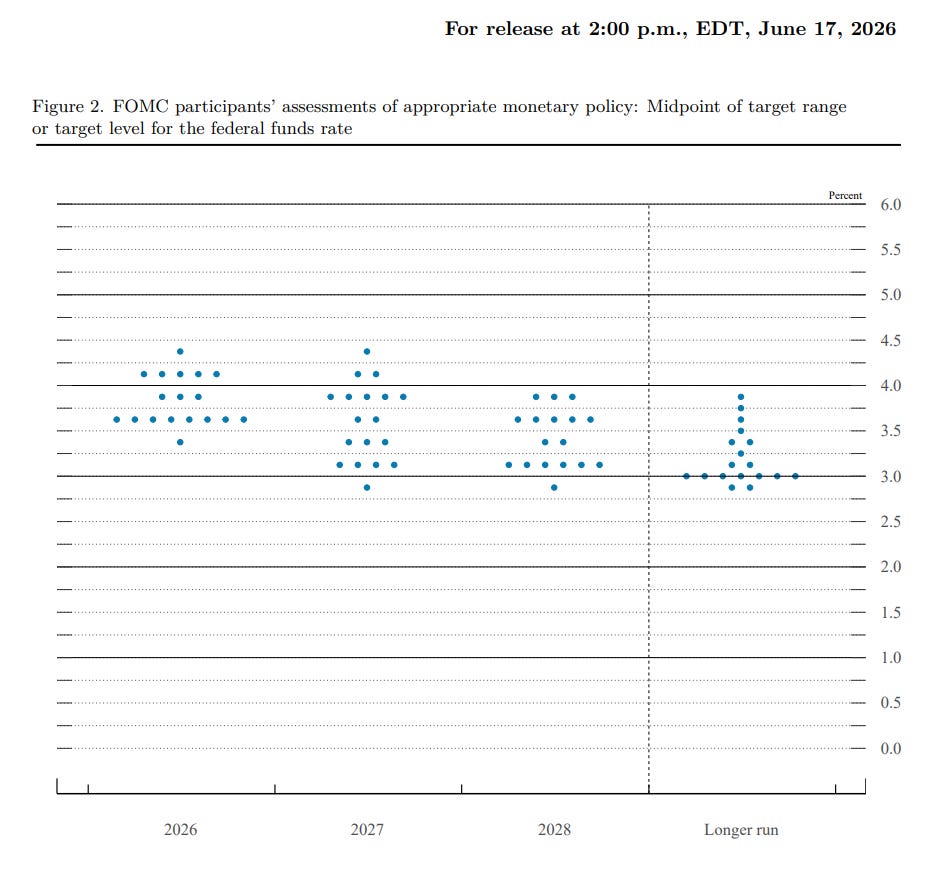
Source : Summary of Economic Projections
Fifty four, forty five
Warsh was confirmed by the Senate 54 to 45, the closest vote of the modern era for a Fed chair. Only one Democrat crossed over. At his confirmation hearing, Senator Elizabeth Warren called him a sock puppet for Trump, who has spent years demanding lower rates and once posted that anyone who disagrees with him will never get the job. Warsh’s answer was direct. He said he would be an independent actor. That sentence meant nothing on the day he said it. Every nominee says it. What he actually did with his first meeting is the only thing that could make it true.
A chair who arrives this way has exactly one asset that matters before anything else: whether the market believes him when he says independent. Cut rates in week one, on cue, with the president who appointed him publicly expecting exactly that, and the bond market does not hear monetary policy. It hears an instruction being followed. It prices in a risk premium for a captured central bank, and that premium shows up as higher long-term yields regardless of what the short end does. So the first move available to a chair in his position is a demonstration before it is a rate decision. Hold, while your own committee leans toward higher rates, while the president who put you there wants the opposite. That is the only way to spend the one asset you actually need before you can spend anything else.
The data gave him cover, but it was also just true
Headline CPI printed at 4.2% this spring, driven largely by the energy shock from the war. The Fed’s own median projection has the year-end rate at 3.8%, not lower, and inflation has now run above the 2% target for more than five years. Nine committee members are projecting a hike before December. None of this required Warsh to invent a hawkish posture for political cover. The data simply did not offer him a dovish one. Whatever the credibility calculation underneath it, the hold was also the only honest reading of the numbers in front of him.
The trade, if the credibility theory holds, runs further out than this single meeting. Hold now, visibly, while the data still justifies it. Let the war resolve, or claim it has. Let oil fall. Let the inflation numbers come down on their own schedule. Then cut, and say the data told him to. Nobody gets to say he was told to.
Whoever picks the ruler picks the conclusion
Two readings of inflation exist right now, and the entire plan depends on which one the Fed eventually treats as authoritative. Headline CPI and PCE put it at 4.2%, with the Fed’s own forecast bringing that to roughly 3.6% by year end, still well above target. A second story points to oil having already fallen sharply from its highs, and if the region stabilizes, that decline pulls headline inflation down on its own. A shift toward an alternative measure, the Dallas Fed’s trimmed mean for instance, strips out exactly the volatile components oil falls into, and the number moves closer to target almost by definition, not because underlying price pressure actually changed but because the ruler changed. Choosing the measurement tool is, in this case, very close to choosing the conclusion.
How the bond market answered
None of that ruler-switching has happened yet, which means for now the bond market is still grading Warsh on the numbers as they currently stand, and its verdict arrived within hours. The mechanism needs a steep yield curve to function, short rates low, long rates high, so banks have an incentive to lever up and absorb Treasury issuance. What the market actually did after the meeting was the opposite of what the plan needs. The short end of the curve, the 2-year Treasury, moved up the most. The long end barely moved. That is curve flattening, and it is the market explicitly pricing in higher rates for longer rather than the relief the mechanism depends on. Dropping forward guidance compounds this. When a central bank stops signaling its intentions, investors price in the uncertainty itself, a risk premium for not knowing, which pushes yields up independent of where actual policy ends up. Layer onto this a problem that predates any of this: the US needs to refinance roughly $8 trillion in debt over the next 12 months, into a market where foreign central banks have stepped back as reliable buyers and where, by some estimates, leveraged funds based in offshore jurisdictions have been absorbing a large share of new issuance instead. That is a buyer base that can be forced to sell into exactly the kind of volatility a flattening curve and a closed strait both produce.
The deal that lasted days
All of this assumed the war would resolve on a workable timeline and it has not. The agreement signed between the US and Iran came apart within days. Israel continued strikes against Hezbollah targets in Lebanon, and Iran closed the Strait of Hormuz again. Whatever credibility Warsh banked at his first meeting now has to last through a war that just reopened rather than one winding down.
Trump was asked about the decision to pause strikes and answered with numbers rather than victory. He talked about oil flow and reserves running out in a matter of weeks, nothing about anything happening on the ground. That lines up exactly with the Strategic Petroleum Reserve timeline flagged in the earlier post in this series. The reserve is what is actually being watched here, far more than the war.
The checklist
Tracking whether this plan is working does not require anyone’s interpretation of Fed language. Five signals are commonly cited as what successful execution of this kind of mechanism should produce: a weaker dollar, higher equities, lower long-term Treasury yields, higher gold, and higher Bitcoin. In the period immediately following the meeting, every single one moved in the opposite direction. Dollar up, stocks down, long-term yields up, gold down, Bitcoin down. None of this means the plan is dead. Mechanisms like this are not won or lost in a single week. But it means the plan, by the standard its own proponents use to judge it, is currently failing, and it is failing at the exact moment the war it depends on ending just got worse instead of better.
The base rate for new chairs
Going back through transitions to new Fed chairs, the S&P 500 has tended to fall in the first three months of a new chair’s term, averaging a meaningful decline, with the largest drops historically associated with chairs who represented the biggest break from their predecessor’s approach. The chairs associated with continuity tended to see smaller, sometimes negligible declines. Warsh is explicitly not a continuity pick. He has said as much himself, in the shorter statements, the dropped forward guidance, the abstention from his own projection. Whether that historical pattern repeats is unknowable in advance. It is at minimum a reason to expect more volatility before less.