

AGI = Artificial Gaslighting Intelligence (for now)
Trillion dollar vibes

Disclaimer: I write about geopolitics and markets. My portfolio holds QQQ and VGT. I use AI tools daily, including in my job. That is not a contradiction. A sector can be fundamentally overvalued in the medium term and still be the dominant growth trade in the short term. I hold it because the momentum is real and it’s never a bad time to be a BogleHead.
AGI stands for Artificial Gaslighting Intelligence. For now.
AI may truly become something genuinely transformative. The people building it believe that sincerely and some of them are probably right about the direction even if wrong about the timeline. This post is about the right now, not that future.
Right now, the largest amount of money ever deployed in human history is being justified by a technology that cannot define its own terms. AGI is the stated destination for most of the investment flowing into this sector. The problem is that nobody agrees on what the hell general intelligence means, nobody agrees on what consciousness means, and David Deutsch, the father of quantum computing, does not believe dogs are intelligent or conscious. I am not making this shit up. We are out here debating whether a Python script can think and this man is like: “dogs are not even alive bro”. At that point you have to step back and ask what exactly we even are all arguing about. You cannot arrive at a destination that has not been defined.
But wait…. It gets worse. Every time LLMs fail a benchmark, that benchmark gets rewritten. Every time they pass one, the definition of intelligence shifts to exclude what they just did. The goalposts are not fixed. They move every time the technology falls short of them. You cannot calculate a return on investment against a target that will not stand still. But the capital is being deployed anyway…
We honestly could be looking at the largest sunk cost fallacy in human history. Trillions already committed to data centers, chips, and energy capacity whose returns have not been proven at the scale required to justify spending that money in the first place. The sunk cost fallacy is when you keep spending because of what you have already spent, not because the future return is clear. At some point the question changes from whether AI will change everything to whether it will change enough, fast enough, to justify what was already spent before the answer was known.
There is a specific financial problem sitting underneath this that almost nobody is discussing. A traditional factory depreciates over 20 to 30 years. An AI data center built on today’s chip clusters faces technological obsolescence in 3 to 5 years as chip designs keep evolving (assuming current rate). The companies building this infrastructure are booking it like long-term real estate, when in fact it has the shelf life of a phone. The return on what they are building degrades faster than the accounting assumes, which means the actual return on invested capital is significantly worse than the balance sheet implies. The equity prices sitting on top of those balance sheets are pricing in the long-term real estate version, not the phone version.
The token problem
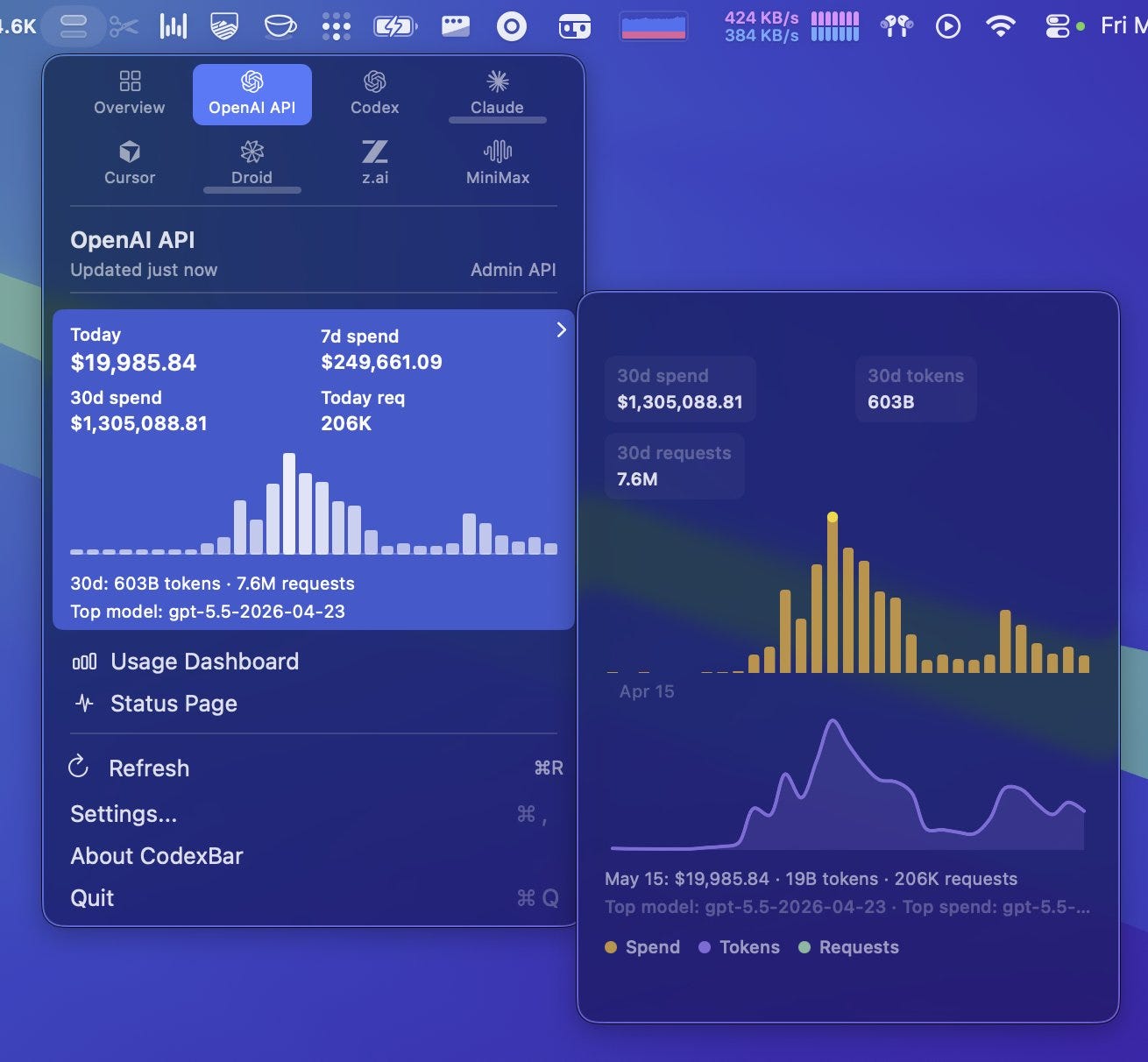
Someone recently posted a screenshot of $1.3 million spent on OpenAI tokens in 30 days, 603 billion tokens, as a demonstration of what AI-powered development looks like at scale. The reaction in most places was AWE... A developer pointed out that this is the same energy as the startup era of 2016 to 2020, when companies had more internal tools than actual customers and nobody questioned whether any of it made sense because it was fashionable and looked good on LinkedIn. The same thing is happening now with tokens. People are getting fired for not using enough AI. Token spend is being used as a measure of productivity. At some point the companies paying those bills will ask who is actually getting things done, not who is spending the most.
Google at its IO conference this year bragged about token usage going from 9.7 trillion in 2024 to 480 trillion in 2025 to 3.2 quadrillion in 2026. Those numbers look exponential on a chart. They feel like a growth story that never ends and is perfect to put in Excel to show everyone. But if you look at the rate of change rather than the absolute numbers, the year-over-year growth multiplier collapsed from roughly 50x down to roughly 6.7x. That is an 86% drop in the growth rate. The absolute number keeps going up but the acceleration is gone. That is the second derivative going negative, and it is the number the infrastructure investment thesis depends on staying positive. Worth noting that these are Google’s numbers specifically. Other providers may look different. But Google is not what you would call a small sample.
An LLM is a system trained to predict the next word given everything it has read. It does this well enough that the output feels like reasoning, feels like understanding, feels like thinking. The feeling is the product. The bot does not have to be intelligent. It just has to be more convincing than the median CEO is skeptical. That bar has been cleared comfortably. The money followed the feeling.
I can smell it… The consulting class is 100% coming. Slop masters. Token coaches. I can already see them on the horizon. Same guys who were blockchain specialists, then NFT specialists, then B2B sales gurus, and now AI specialists.
Btw, leave the Doggos alone. They are more intelligent than most people I know.
You can polish a lie forever
More parameters make the outputs more convincing. They do not make the system understand anything in any sense that has been agreed upon. You can polish a lie forever and it never becomes the truth. The outputs get better of course, but what is underneath is the same. That gap between what these tools are good at and what the investment story requires them to be good at is where the sunk cost fallacy lives. That gap is being covered by narrative rather than by results.
Artificial Gaslighting Intelligence. For now.
This is spot on - the big AI companies are trying to sell something they cannot even define. AI is a fine marketing tool, but the claim of AGI is so much larger. The 'general' part requires an incredible jump on the level of logic/psychology/epistemology style claims. Within epistemology its a well known result that induction (the formal tool of generalization and abstraction) cannot be derived non-circularly. Induction is treated as a given in formal systems, and no amount of data fed into a LLM will reproduce this ability. Generalized abstraction is upstream of data, not downstream of it.
I actually think that within a given scope current AI models are already better at data processing than a person, but the human aspect it cannot mimic is that the human's reasoning is entirely unbound to that scope. So its no surprise their focus is on tokens used. Since that's what they sell, they will always advocate for it. Its going to be the responsibility of managements to create criteria for productivity that are actually useful for their business. Its just like in the 2000's when the focus was on lines of code written, which simply ended up incentivizing creating long and inefficient software.
The gaslighting read is sharper than it looks — a model tuned to agree reflects your premise back as confirmation. That's not intelligence, it's a mirror with no spine. The fix isn't a smarter model, it's a human who can tell reflection from truth. Wrote a book on exactly that, free Kindle thru 6/3: amazon.com/dp/B0H3HY8W9F